
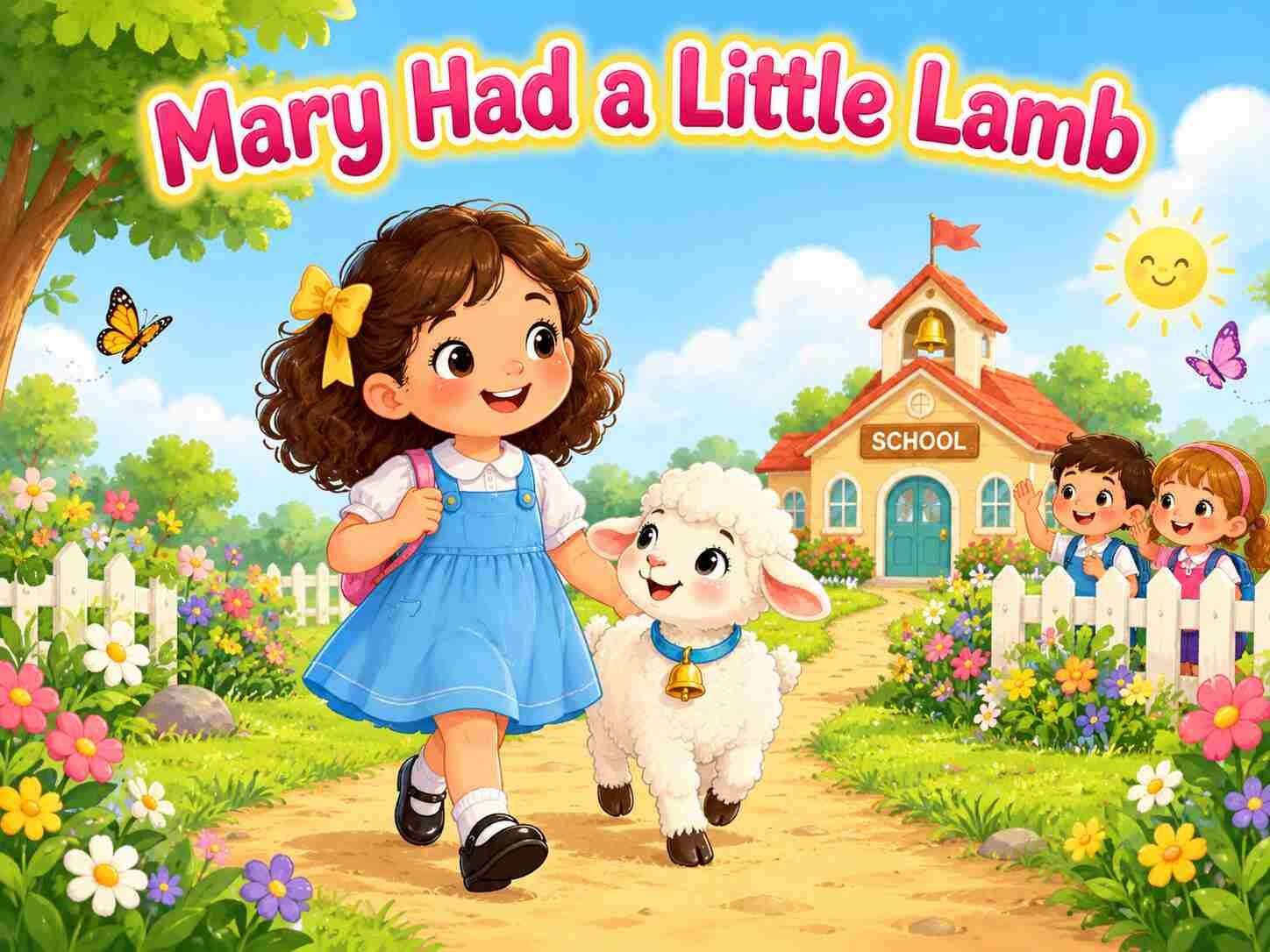
Mary Had a Little Lamb is a traditional English-language poem first published in the United States. It suits preschoolers who enjoy animal stories, simple rhythms and repeated words. Singing and reciting it can help children explore rhymes, listening and kindness.
Key Takeaways
- Sarah Josepha Hale published the poem in 1830.
- The story follows Mary and her devoted little lamb.
- The poem encourages kindness towards animals and other living things.
- Words such as snow and go provide simple rhyming examples.
- Singing, actions and picture cards can make learning enjoyable.
- Some details about the poem’s inspiration remain disputed.
Have you ever seen a little lamb follow someone everywhere? Mary Had a Little Lamb tells a playful story about a girl and her animal friend. The lamb follows Mary to school, surprising the children and teacher.
This familiar Mary Had a Little Lamb song has been enjoyed by generations of families. Its steady rhythm and repeated ideas make it easy to recite together. Children can listen, join in with familiar lines and talk about the story.
The English rhyme Mary Had a Little Lamb first appeared as a poem in the United States. Sarah Josepha Hale published it in 1830. The poem is longer than many versions children sing today.
Parents and teachers can use Mary Had a Little Lamb lyrics for simple language activities. Children can spot rhyming words, copy gentle actions and discuss how Mary treats her lamb. These activities work well at home, in nursery settings or during story time.
Mary Had a Little Lamb Nursery Rhyme with Lyrics
This traditional poem tells how a little lamb follows Mary to school. Read it slowly, then invite children to join in with familiar lines.
Mary had a little lamb,
Its fleece was white as snow,
And everywhere that Mary went
The lamb was sure to go;
He followed her to school one day—
That was against the rule,
It made the children laugh and play,
To see a lamb at school.
And so the teacher turned him out,
But still he lingered near,
And waited patiently about,
Till Mary did appear.
And then he ran to her, and laid
His head upon her arm,
As if he said, “I’m not afraid—
You’ll keep me from all harm.”
“What makes the lamb love Mary so?”
The eager children cry—
“O, Mary loves the lamb, you know,”
The teacher did reply—
“And you each gentle animal
In confidence may bind,
And make them follow at your call,
If you are always kind.”
Quick Facts for Preschoolers and Kids
- Origin: The poem was first published in the United States.
- Writer: Sarah Josepha Hale is credited as its documented author.
- Year: Its first known publication was in 1830.
- Original title: It appeared as Mary’s Lamb.
- Tune: Lowell Mason set the words to music in the early 1830s; exact musical details vary across sources.
- Inspiration: The poem may relate to a real girl and her lamb, but the story is disputed.
- Fun fact: Thomas Edison used the opening words when demonstrating his phonograph in 1877.
What Is Mary Had a Little Lamb About?
The poem is about Mary and her little lamb. The lamb follows her wherever she goes, even to school. Its arrival surprises the children and causes laughter in the classroom.
The teacher sends the lamb outside, but it waits nearby for Mary. When they meet again, the lamb shows how closely it is attached to her. The poem ends by explaining that kindness can help people build trust with animals.
Parents can ask children why the lamb follows Mary. They might also discuss how to treat animals gently and safely. Remind children that real animals need suitable care and should always be handled with an adult’s guidance.
Rhyming Words in Mary Had a Little Lamb
This poem offers examples of nursery rhymes with rhyming words that children can hear and say aloud. Read each pair slowly, and notice how the ending sounds match.
- Snow – go
- Day – play
- Near – appear
- Arm – harm
- Cry – reply
- Bind – kind
The poem uses several different rhyme patterns rather than one simple pattern throughout. Children can clap when they hear matching end sounds.
Mary Had a Little Lamb: Words and Sounds
Nursery rhymes and songs give children a playful way to hear familiar words. Read the poem together and explain new words using pictures or actions.
Sight Words
Practice these ten useful words from the poem:
- Mary
- Had
- A
- Little
- And
- The
- Her
- To
- It
- You
Phonics Words
Say each word slowly, then listen for its sounds.
- Lamb – /l/ /a/ /m/: three sounds.
- Had – /h/ /a/ /d/: three sounds.
- Snow – /s/ /n/ /ō/: the “ow” makes a long O sound.
- Go – /g/ /ō/: the “o” makes a long O sound.
- Day – /d/ /ā/: the “ay” makes a long A sound.
- Play – /p/ /l/ /ā/: the “ay” makes a long A sound.
- School – /s/ /k/ /oo/: the “oo” makes a long OO sound.
- Near – /n/ /ear/: the ending has an “ear” sound.
- Kind – /k/ /ī/ /n/ /d/: the “i” makes a long I sound.
- Arm – /ar/ /m/: the “ar” makes an “ar” sound.
Sound examples are simplified for early practice. English pronunciation can vary by accent.
Fun Activities for Preschoolers and Kids
This popular nursery rhyme can inspire simple games at home or school. Keep activities playful, brief and suitable for each child’s age.
-
Make a Paper Lamb
Draw a lamb on paper and add cotton wool to its body. An adult should supervise the use of glue and small craft pieces.
-
Act Out the Story
One child can pretend to be Mary while another acts as the lamb. Walk slowly around the room, then stop at an imaginary school.
-
Find the Rhyming Words
Say snow and ask children to find its rhyming partner, go. Repeat with day and play, using clear and cheerful voices.
-
Count the Lambs
Draw three or four lambs on paper and count them together. Children can point to each picture as they say each number.
-
Talk About Kindness
Ask children how Mary might care for her lamb. Encourage ideas such as offering suitable food with adult help and treating animals gently.
What Children Can Learn From This Rhyme
- Language: Repeated words can introduce familiar vocabulary and simple sentence patterns.
- Listening: Following the story can encourage children to listen for details.
- Memory: Reciting short lines can give children practice remembering words in order.
- Movement: Walking, clapping and acting can make rhyme time active.
- Feelings and social skills: The story offers a chance to discuss kindness, care and friendship.
Children learn at different rates, so keep activities relaxed. Praise their effort rather than expecting perfect recitation.
FAQs
1. Who Wrote Mary Had a Little Lamb?
Sarah Josepha Hale is credited as the author of the earliest known published version. She published Mary’s Lamb in 1830. A later claim linked the poem to John Roulstone, but that claim remains disputed due to a lack of convincing contemporary evidence.
2. When Was Mary Had a Little Lamb Written?
The poem was published in 1830. Some sources discuss an earlier origin story involving a girl and her lamb, but the details cannot be fully verified. It is safest to use 1830 as the documented publication year.
3. What Is the Meaning of Mary Had a Little Lamb?
The poem describes a lamb’s strong attachment to Mary. Its closing lines suggest that kindness can build trust between people and animals. Parents and teachers can use the story to start a gentle conversation about caring for living things.
4. What Are the Rhyming Words in Mary Had a Little Lamb?
Examples include snow and go, day and play, and near and appear. Children can say each pair aloud and listen for the matching ending sounds. Clapping or tapping can help make the activity more engaging.
5. What Age Is Mary Had a Little Lamb Suitable For?
Many children aged three to six can enjoy listening to or reciting this rhyme. Younger children may prefer short sections and actions, while older preschoolers can explore rhyming words and vocabulary. Adjust the activity to each child’s interest and attention.
Mary Had a Little Lamb brings together a memorable story, gentle rhythm and simple rhymes. Parents and teachers can make it more engaging through singing, movement and conversation. Use it as one of many nursery rhymes for preschoolers that encourage language play and thoughtful discussions about kindness.
Popular Nursery Rhymes for Toddlers and Kids
- Twinkle, Twinkle, Little Star
- Baa, Baa, Black Sheep
- Humpty Dumpty
- Jack and Jill
- Hickory Dickory Dock
- Hey Diddle Diddle
- Row, Row, Row Your Boat
- The Wheels on the Bus
- Old MacDonald Had a Farm
- Incy Wincy Spider