

These free uppercase letter A tracing worksheets help preschoolers and kindergarteners learn the stroke order, trace the letter, and practise writing it on guide lines. You get three printable sheets: a dotted A with start dots and arrows, a trace-and-write sheet, and an A is for Apple sheet. Print one, grab a pencil or crayon, and practise for five to ten minutes a day.
Key Takeaways
- Uppercase A uses three straight strokes: down to the left, down to the right, and a line across the middle.
- Numbered start dots and arrows show children where to begin and which way to go.
- Three worksheets move from full tracing to tracing and writing, then to tracing the letter inside real words.
- Short sessions of five to ten minutes work better than one long sitting.
- Finger tracing, sand trays, and crayons make the practice playful before pencil work begins.
Learning to write the letter A is one of the first big steps in early handwriting. Uppercase A is a friendly letter to start with because it is made only of straight lines, with no curves to manage. A tracing worksheet gives young children a clear path to follow, so they can practise the shape, direction, and size of the letter before writing it on their own.
This page gives you three free printable uppercase letter A tracing worksheets, a simple stroke-order guide, practice tips, and answers to common questions from parents and teachers.
Uppercase Letter A Tracing Worksheets
Each worksheet has a name and date line, clear writing guide lines, and the BeezyLearning.com label in the border. Start with the first sheet and move on when your child feels confident.
Worksheet 1: Uppercase Letter A Tracing Worksheet
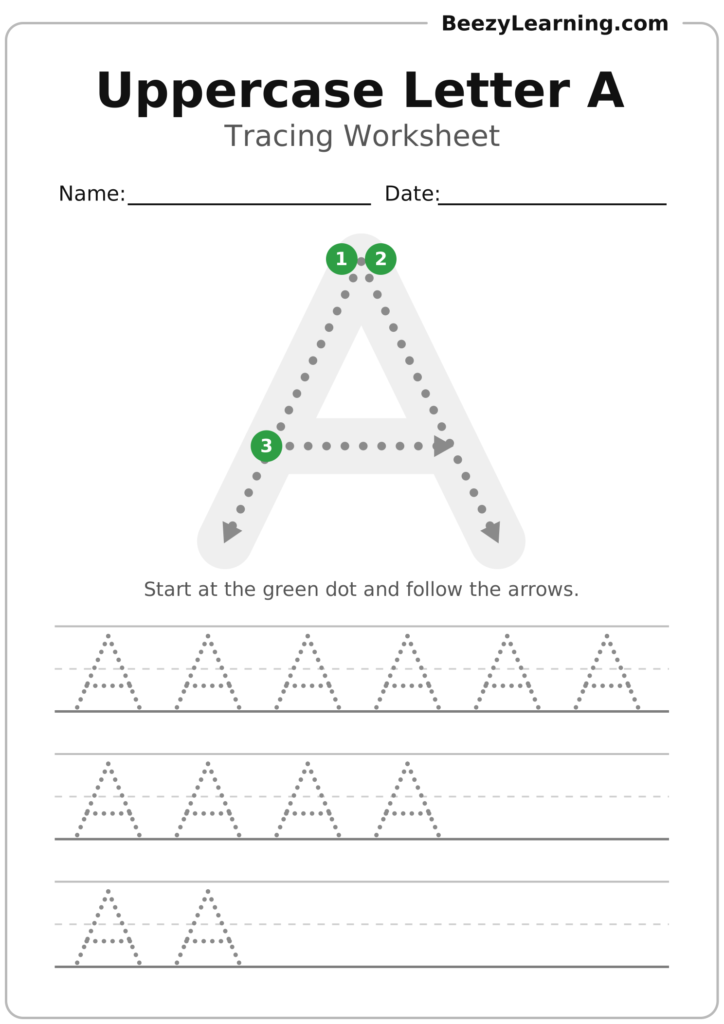
This worksheet shows a large dotted letter A with numbered green start dots and arrows. Children trace the three strokes in order, then practise on three rows of guide lines with fewer and fewer dotted letters to follow. It suits children who are just meeting the letter.
Worksheet 2: Trace and Write Uppercase Letter A
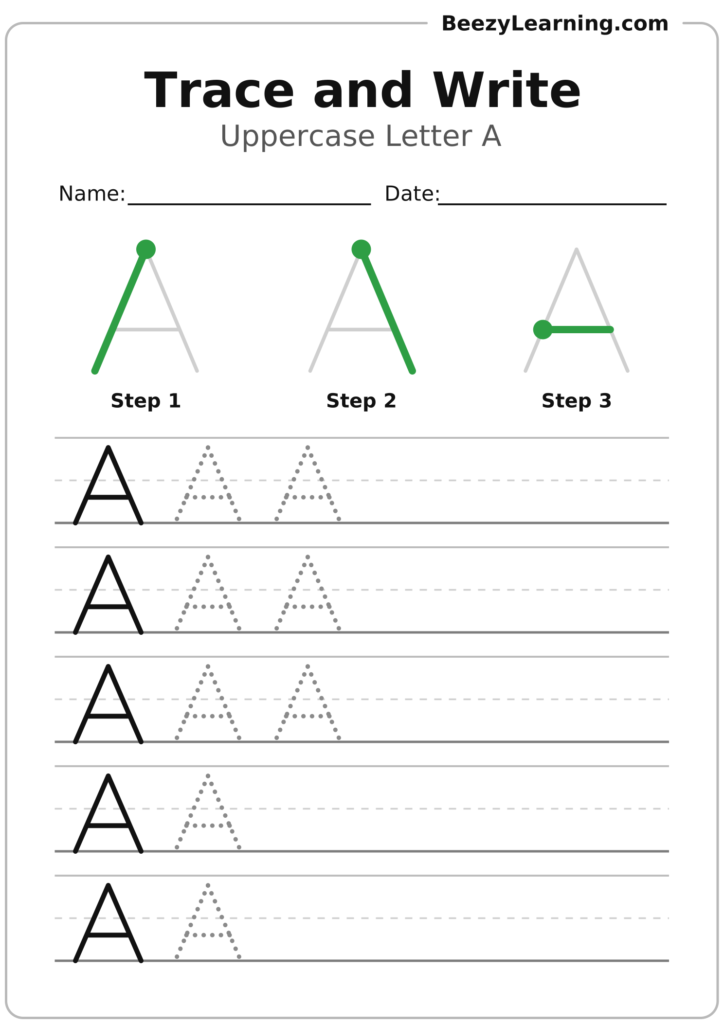
Three step boxes show how the letter is built, one stroke at a time. Each row begins with a solid model A, followed by dotted letters to trace and open space to write on their own. It suits children who can already follow the shape and are ready to write independently.
Worksheet 3: A is for Apple Tracing Worksheet
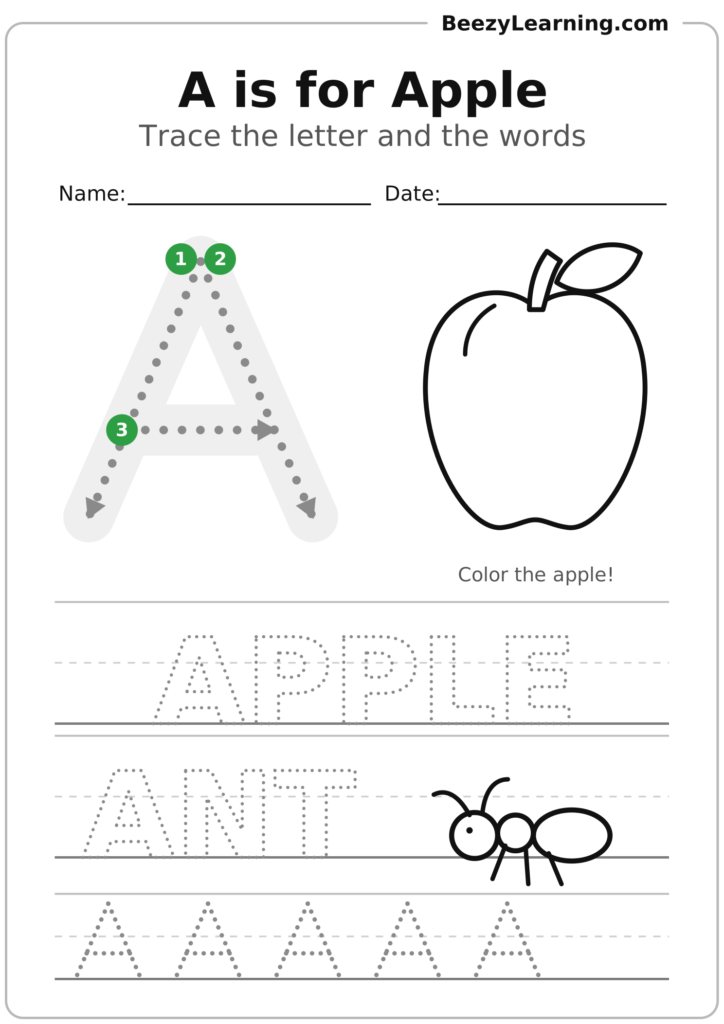
This sheet links the letter to words. Children trace a large A, trace the words APPLE and ANT, color the apple, and finish with a row of dotted letter As. It suits children who know the shape and are learning that letters belong to words and sounds.
How to Write an Uppercase Letter A
Teach the same three steps every time so the movement becomes automatic.
- Start at the top and slant down to the left.
- Go back to the top and slant down to the right.
- Draw a short line across the middle, from left to right.
Things to watch for while your child practises:
- Pointed top: the two slanted lines should meet at the top to make a point, not a flat or round top.
- Crossbar position: the middle line sits about halfway down the letter, not at the very bottom.
- Even slant: both legs should lean the same amount so the letter looks balanced.
- Start at the top: starting at the bottom makes the letter harder to form, so remind your child to begin at the green dot.
Skills Your Child Practises
- Letter recognition: seeing and naming the uppercase A.
- Stroke order and direction: learning where to start and which way to move.
- Fine motor control: holding a pencil or crayon and following a line.
- Hand-eye coordination: keeping the pencil on the dotted path.
- Letter-sound awareness: linking A with the first sound in apple and ant.
Tips for Using the Tracing Worksheets
- Start with big movements: trace a large A in the air or on the table with a finger before using a pencil.
- Use a sand or salt tray: drawing the letter in a shallow tray adds a sensory step that many children enjoy.
- Keep sessions short: five to ten minutes is plenty for young children, and you can repeat the worksheet on another day.
- Praise effort: celebrate each careful stroke rather than only a perfect letter.
- Reuse the sheets: slip a worksheet into a plastic sleeve and trace with a dry-erase marker for repeated practice.
- Say the strokes aloud: a short phrase such as “down, down, across” helps children remember the order.
Which Worksheet Should You Start With?
| Worksheet | Best for | Age Group |
|---|---|---|
| Worksheet 1: Uppercase Letter A Tracing | First time tracing the letter | 3 to 4 years |
| Worksheet 2: Trace and Write Uppercase A | Practising the stroke order independently | 4 to 5 years |
| Worksheet 3: A is for Apple | Linking the letter to words and sounds | 4 to 6 years |
These age ranges are a guide only. Every child develops at their own pace, so choose the sheet that feels comfortable for your child.
Frequently Asked Questions
1. What is the correct stroke order for uppercase A?
Start at the top and slant down to the left. Go back to the top and slant down to the right. Then draw a short line across the middle from left to right.
2. At what age can children start tracing uppercase A?
Many children enjoy guided tracing between ages 3 and 5, but readiness varies. Start with finger tracing and large shapes, and move to pencils when your child holds a crayon with control.
3. Why is tracing helpful before writing letters independently?
Tracing gives children a visual path to follow. It helps them practise the shape, direction, and size of a letter before they write it without any guides.
4. Should children learn uppercase or lowercase letters first?
Both approaches work. Many teachers begin with uppercase letters because the shapes use straight lines and are easier to form, while others begin with the letters in the child’s name.
5. How long should a tracing session be?
Short sessions of five to ten minutes work best for young children. Stop when your child gets tired and return to the worksheet another day.
6. How can I make tracing more fun?
Trace the letter in the air, in sand, or in a tray of salt before using crayons on the worksheet. Let your child color the apple on the third sheet and praise their effort.
7. Can teachers use these worksheets in the classroom?
Yes, teachers can use them for literacy centres, morning work, and homework. A plastic sleeve and a dry-erase marker let one printed sheet be reused many times.
8. Can parents print these worksheets?
Printing is possible when authorized printable image or PDF files are available. Print on A4 or letter paper at 100% scale so the writing lines stay clear.
Conclusion
Uppercase letter A tracing worksheets turn a first handwriting lesson into a calm, step-by-step activity. With clear start dots, arrows, and guide lines, children can build confidence one stroke at a time. Use the three worksheets in order, keep practice short and positive, and move on to the next letter when your child is ready.
Related Worksheets
- Lowercase Letter a Tracing Worksheet
- Uppercase Letter B Tracing Worksheet
- Alphabet Tracing Worksheets A to Z
- Letter A Coloring Page: A is for Apple
- Letter A Worksheets for Preschool
- Pre-Writing Lines and Curves Worksheet
- Name Tracing Worksheet
- Uppercase and Lowercase Letter Matching Worksheet